
US core PCE inflation set to tick up in April as markets price in Fed rate hikes ahead
- The core Personal Consumption Expenditures Price Index is forecast to rise 0.3% MoM and 3.3% YoY in April.
- Headline annual PCE inflation is expected to rise to its highest level in three years at 3.8%.
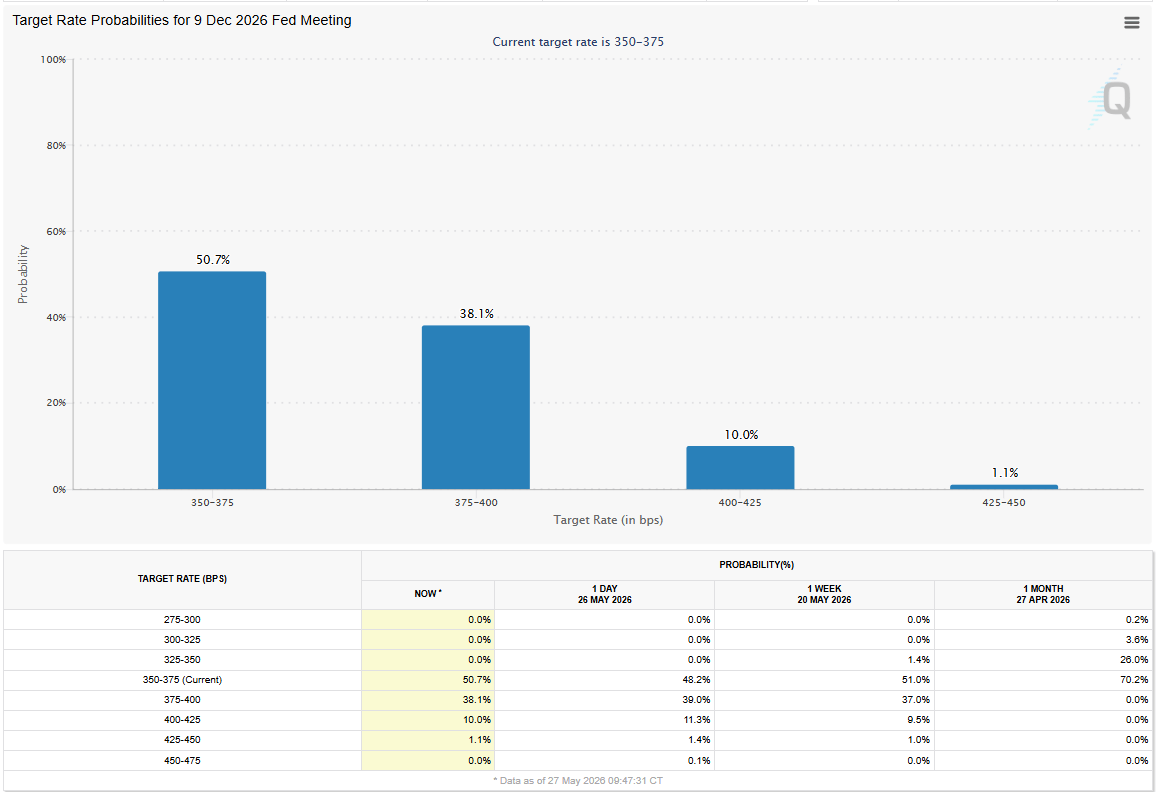
- Markets see about a 50% chance of the Federal Reserve raising the policy rate at least once by end-2026.
The United States (US) Bureau of Economic Analysis (BEA) will publish the Personal Consumption Expenditures (PCE) Price Index data for April on Thursday at 12:30 GMT.
The PCE Price Index is closely watched by market participants because it is the Federal Reserve’s (Fed) preferred measure of inflation and could influence the policy outlook.
Anticipating the PCE: Insights into the Federal Reserve's key inflation metric
The core PCE Price Index, which excludes volatile food and energy prices, is expected to advance 0.3% month-over-month (MoM) in April, matching March’s increase.
In 12 months to April, the core PCE inflation is set to edge higher to 3.3%. Meanwhile, the headline annual PCE inflation is forecast to reach its highest level since May 2023 at 3.8%.
Markets will scrutinize the PCE Price Index data as Fed officials take this inflation gauge into account when deciding on the next policy move. Given the uncertainty created by the ongoing Middle East conflict, investors will assess the details of the PCE inflation report to see whether the US central bank is likely to opt for an interest rate hike before the end of the year.
According to the CME FedWatch Tool, markets are currently pricing in about a 50% probability that the Fed will raise the policy rate by at least 25 basis points by end-2026.
In an interview with Reuters on Wednesday, Minneapolis Fed President Neel Kashkari, who dissented at the April policy meeting and voted against the inclusion of the easing bias in the policy statement, noted that data released since the last meeting have shown that inflationary risks are higher. In the meantime, Fed Governor Christopher Waller, known for his dovish outlook, shifted his tone last week and said that he should remove the easing bias from the statement. Waller further added that he would not hesitate to support an increase in the policy rate if inflation expectations were to become unanchored.
Previewing the PCE inflation report, TD Securities said:
“We expect core and headline PCE prices moderated in April to 0.26% and 0.43% m/m, respectively. Tariff passthrough was moderate in the month, and a slowdown in supercore services offset strength in shelter. Our forecast translates to 3.3% and 3.8% y/y for core and headline, respectively. We also look for nominal and real personal spending to slow down in the month.”
Economic Indicator
Core Personal Consumption Expenditures - Price Index (MoM)
The Core Personal Consumption Expenditures (PCE), released by the US Bureau of Economic Analysis on a monthly basis, measures the changes in the prices of goods and services purchased by consumers in the United States (US). The PCE Price Index is also the Federal Reserve’s (Fed) preferred gauge of inflation. The MoM figure compares the prices of goods in the reference month to the previous month.The core reading excludes the so-called more volatile food and energy components to give a more accurate measurement of price pressures. Generally, a high reading is bullish for the US Dollar (USD), while a low reading is bearish.
Read more.Next release: Thu May 28, 2026 12:30
Frequency: Monthly
Consensus: 0.3%
Previous: 0.3%
Source: US Bureau of Economic Analysis
After publishing the GDP report, the US Bureau of Economic Analysis releases the Personal Consumption Expenditures (PCE) Price Index data alongside the monthly changes in Personal Spending and Personal Income. FOMC policymakers use the annual Core PCE Price Index, which excludes volatile food and energy prices, as their primary gauge of inflation. A stronger-than-expected reading could help the USD outperform its rivals as it would hint at a possible hawkish shift in the Fed’s forward guidance and vice versa.
How will the Personal Consumption Expenditures Price Index affect EUR/USD?
The US Dollar (USD) stays resilient against its rivals this week. Still, it struggles to gather strength as investors refrain from taking large positions due to the uncertainty surrounding the conflict between the United States (US) and Iran.
Earlier in the week, the US carried out what it called "self-defense strikes" on Iranian missile sites and mine-laying vessels. In turn, Iran's Islamic Revolutionary Guard Corps (IRGC) threatened to retaliate, calling the US's action a violation of the ceasefire. Nevertheless, the truce officially remains in place, while the sides are reportedly working toward finalizing a Memorandum of Understanding (MOU), specifically trying to resolve disputes over language regarding Iran's nuclear program and sanctions relief.
If the US and Iran reach an agreement to fully open the Strait of Hormuz, crude Oil prices could decline sharply and ease fears over global inflation running out of control. In this scenario, the USD could remain under bearish pressure and help EUR/USD turn north even if the PCE inflation data come in above analysts’ estimates.
In case the US-Iran issue remains unresolved by the time the inflation data is released, it could have a noticeable effect on the USD’s valuation. A stronger-than-forecast print in the monthly core PCE Price Index could boost the USD with the immediate reaction and hurt EUR/USD, as it would suggest that rising energy costs are lifting price pressures in the wider economy. Conversely, a soft print in this data could make it difficult for the USD to gather strength and allow EUR/USD to hold its ground.
Eren Sengezer, European Session Lead Analyst at FXStreet, shares a brief technical outlook for EUR/USD:
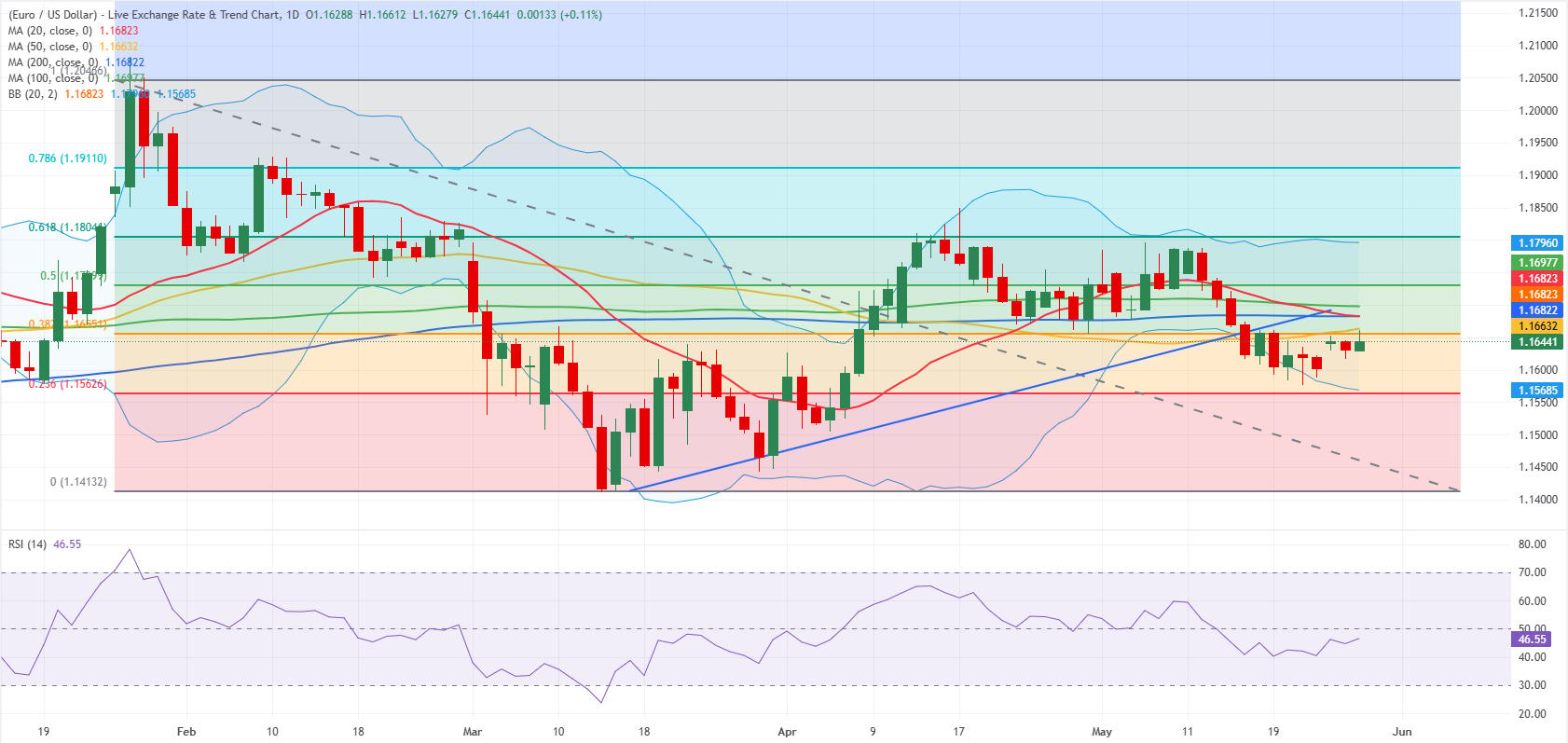
“The near-term technical outlook for EUR/USD points to a bearish bias but doesn’t show a buildup in momentum. The pair remains in the lower half of the Bollinger Bands on the daily chart and trades below the 20-day, 50-day, 100-day and the 200-day Simple Moving Averages (SMA).”
“On the downside, 1.1560, where the Fibonacci 23.6% retracement level of the late-January to mid-March downtrend meets the lower limit of the Bollinger Bands, aligns as key technical support. A daily close below this level could attract technical sellers and open the door to an extended decline toward 1.1400 (static level).”
“Looking north, a strong resistance area seems to have formed at the 1.1670-1.1700 region (20-day SMA, 100-day SMA, 200-day SMA) ahead of 1.1800 (Fibonacci 61.8% retracement, upper limit of the Bollinger Bands).
Fed FAQs
Monetary policy in the US is shaped by the Federal Reserve (Fed). The Fed has two mandates: to achieve price stability and foster full employment. Its primary tool to achieve these goals is by adjusting interest rates. When prices are rising too quickly and inflation is above the Fed’s 2% target, it raises interest rates, increasing borrowing costs throughout the economy. This results in a stronger US Dollar (USD) as it makes the US a more attractive place for international investors to park their money. When inflation falls below 2% or the Unemployment Rate is too high, the Fed may lower interest rates to encourage borrowing, which weighs on the Greenback.
The Federal Reserve (Fed) holds eight policy meetings a year, where the Federal Open Market Committee (FOMC) assesses economic conditions and makes monetary policy decisions. The FOMC is attended by twelve Fed officials – the seven members of the Board of Governors, the president of the Federal Reserve Bank of New York, and four of the remaining eleven regional Reserve Bank presidents, who serve one-year terms on a rotating basis.
In extreme situations, the Federal Reserve may resort to a policy named Quantitative Easing (QE). QE is the process by which the Fed substantially increases the flow of credit in a stuck financial system. It is a non-standard policy measure used during crises or when inflation is extremely low. It was the Fed’s weapon of choice during the Great Financial Crisis in 2008. It involves the Fed printing more Dollars and using them to buy high grade bonds from financial institutions. QE usually weakens the US Dollar.
Quantitative tightening (QT) is the reverse process of QE, whereby the Federal Reserve stops buying bonds from financial institutions and does not reinvest the principal from the bonds it holds maturing, to purchase new bonds. It is usually positive for the value of the US Dollar.